
Centralized Government and the Tension Between Practice and Polity
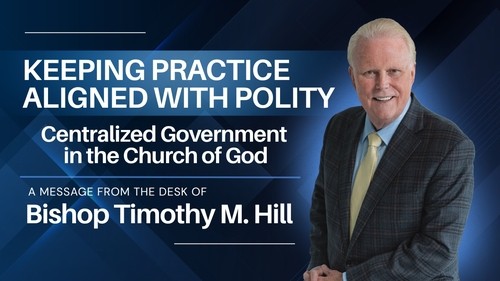
Centralized Government
and the Tension Between
Practice and Polity
By: Tim Hill
A brief word before I begin: What I address here is something I have observed in various ways for many years. It predates several administrations, including my own. This is not intended as a criticism of any particular leader or period of leadership, but as an acknowledgment of a longstanding tension between polity and practice that I believe deserves careful thought.
Churches and denominations have organized themselves in different ways throughout history.
Some are congregational, placing considerable governing responsibility within the local church. Others reflect a presbyterian form of structure, with governance exercised through representative councils and shared leadership. Still others follow an episcopal structure, with bishops and overseers entrusted with defined responsibilities within the larger church.
Those forms of church government have served the church bodies that embraced them. The Assembliesof God has its structure. Baptist churches have theirs. The Pentecostal Holiness Church has its own. Their early leaders made governing choices that helped shape who they became.
Early leaders of the Church of God also made a choice. They helped establish a distinct governmental structure known as centralized government.
Reflecting one of the early decisions made at the first General Assembly in 1906, our Minutes state:
“Believing a centralized form of government to be the Biblical (Acts 15:13–29) standard for our churches, the Church of God (Cleveland, Tennessee, U.S.A.) early adopted such a form of government and has consistently practiced a centralized form of government.”
That is a significant statement.
While at times it may seem that features of those other forms appear within our structure, the General Assembly Minutes recognize only one governing form for the Church of God: centralized government.
Within that centralized structure, responsibilities are vested at the general, state, and local levels, all functioning within the governing order established by the International General Assembly.
That is centralized government as we have known it, and I believe it has served the Church of God well.
However, I learned early that polity is not merely something written in the Minutes; sooner or later, it becomes personal.
As a young evangelist, I was once called into the office of my state overseer and cautioned about a revival I was preaching for another fellowship. His concern was that my being there might influence some people of our denomination in that direction. I remember thinking that he probably attributed more influence to me than I actually had. I still think that.
I can smile at that now. But at the time, it felt like a pretty sharp sting to a young evangelist who thought he was simply walking through some doors that were opening. That was nearly fifty years ago—and thankfully, given the relationships I’ve enjoyed across denominational lines, I haven’t been called in on that one in a while.
Still, the experience taught me something early: polity is not merely something written in the Minutes. It eventually shows up in how ministry is practiced.
As the years went by, it became appropriate to develop Tim Hill Ministries. Years earlier, the Executive Council had established a process through which such ministries could be approved and remain accountable within the Church.
And that brings me to the point.
The issue is not whether this practice or that practice should be sanctioned.
It is not primarily about one exception, one decision, one office, or one circumstance.
The larger question is:
Do we really want centralized government?
If we do, then we must recognize that centralized government is sustained by more than language in the Minutes. It also depends upon the way we practice what those Minutes establish.
There will always be situations that require judgment. There will always be circumstances that seem to justify an exception. There will always be reasons to stretch an established practice a little farther.
Any one decision may appear harmless.
But polity can be affected by accumulation.
One exception can establish a precedent. A precedent can make another exception easier. Responsibilities that were once clearly distinguished can begin to overlap. Lines established by the General Assembly can become less distinct in practice.
Eventually, what we do can begin to look somewhat different from what we say we are.
That is where caution is warranted.
For centralized government to work as intended, the lines of responsibility need to remain clear.
Local churches have meaningful responsibilities.
State leadership has responsibilities vested within the structure.
General leadership carries responsibilities for the broader Church.
These are not competing interests. They are parts of an interconnected system designed to function together.
But when practices repeatedly stretch those relationships, the lines can begin to blur.
And blurred lines eventually affect the system itself.
That is one reason clear lines of accountability matter. They do more than define responsibility; they help preserve continuity in what the Church teaches and how that teaching is carried forward. Government does not create doctrine, but it can provide the order through which doctrinal clarity is maintained from one level of the Church to another.
That is why the larger question is more important than debating every individual circumstance.
We can spend considerable time asking:
Can we do this?
Can an exception be made here?
Can this longstanding practice be adjusted?
Those may all be legitimate questions.
But another question should come first:
What does this do to the centralized form of government we have chosen to maintain?
That question moves the discussion beyond personalities and individual decisions and brings it back to principle.
If centralized government is merely terminology, then stretching its lines probably matters very little.
But if it expresses something important about how the Church of God understands itself—how the local church relates to the state, how the state relates to the general Church, and how the decisions of the International General Assembly are carried into practice—then those lines matter greatly.
For me, the issue is not whether centralized government has a place in the Church of God. Our history and polity have already answered that.
The real question is whether our practice will continue to support what we have affirmed. Because when practice stretches beyond polity, accountability can become less clear.
The Minutes provide the framework. The International General Assembly provides the governing voice. Responsibilities are vested throughout the Church within that order.
So the question is not simply, “Do we approve of this practice or that one?”
The more important question is:
“Does this practice strengthen or weaken the centralized government we say we believe in?”
Until the Church of God General Assembly decides otherwise, keeping practice aligned with polity is essential.
Recent
Archive
Categories
no categories
1 Comment
Dear Brother Tim, Lynn and I and All our family are so grateful for you and Paulas Gifts and Personal Sacrifice all these years of faithful service! Thanks Be Unto God for Your Unspeakable Gift to the Us and The Body Of Christ And Gods Kingdom Work On Earth! Brother and Sister Hill We Love You Dearly and We Will Always Be Here For You And The Children And Every Word We Have Spoke will Come To Pass For Gods Glory And Your Good! Love Brother Milton